Emily Dake on Creative Reuse, Holding Stories, and Running a Nonprofit
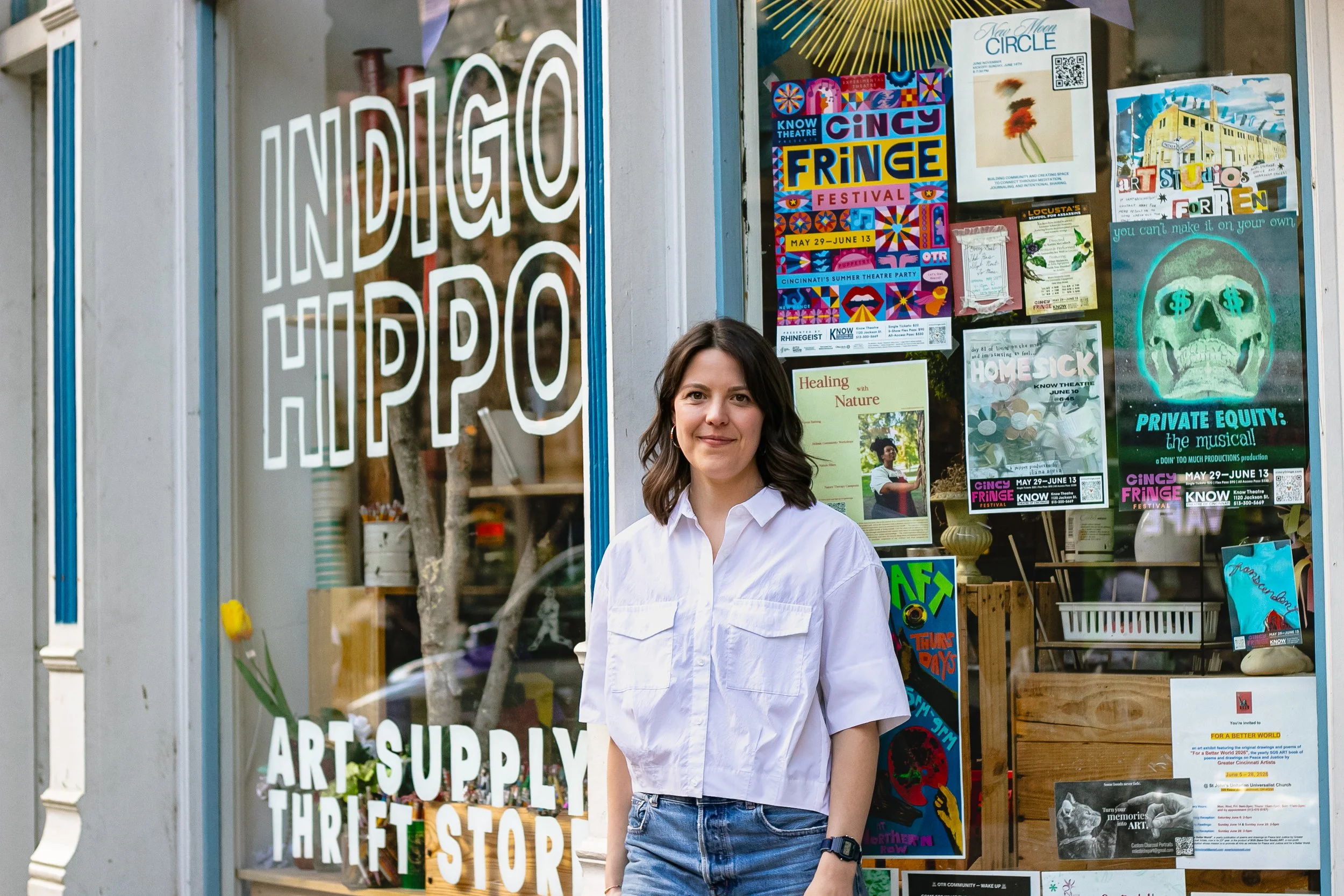
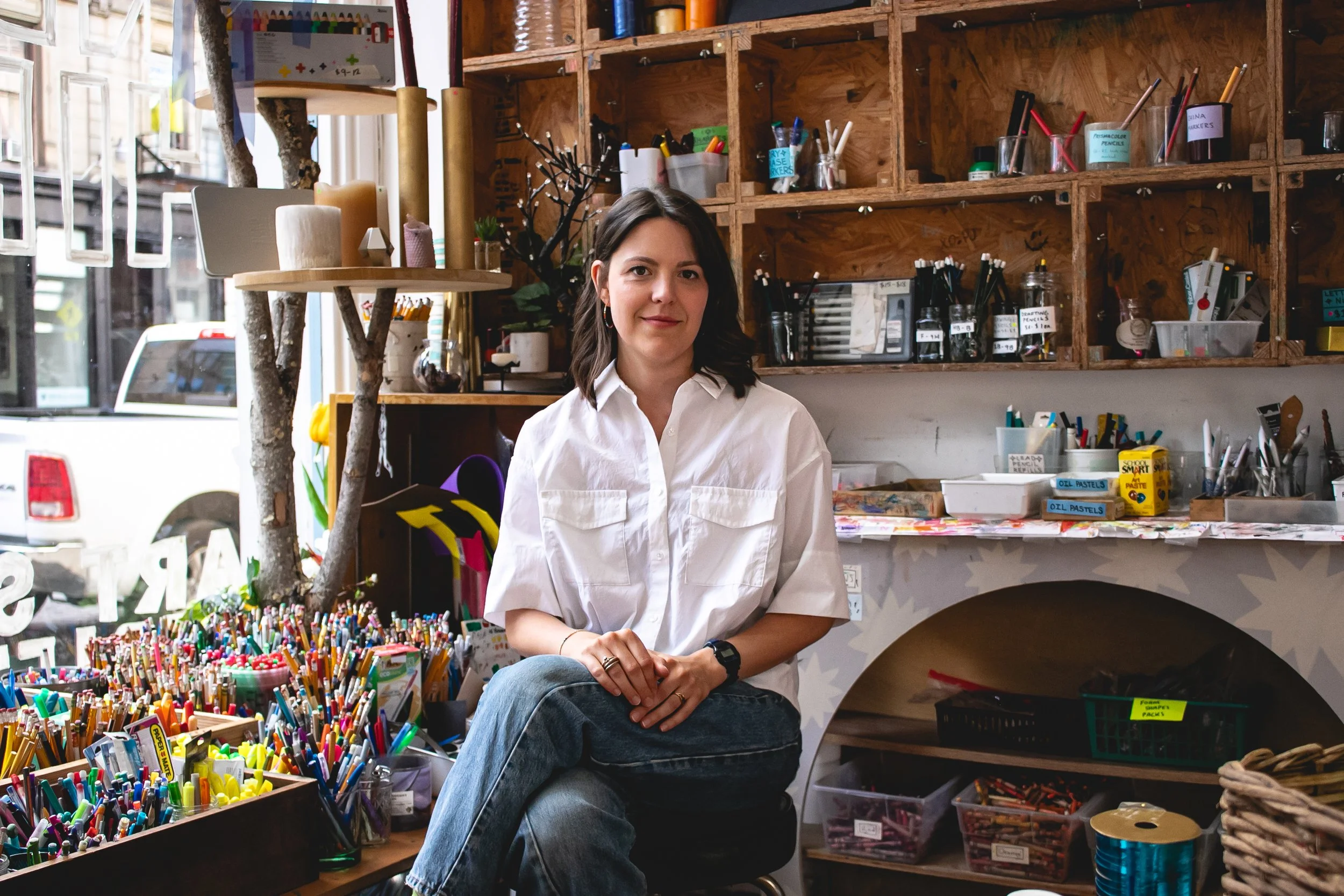
Indigo Hippo is a compact storefront filled with colored pencils, fabric, beads, paper, and lots of treasures and trinkets for creative work. But more than that, the creative reuse center is a community hub in Over-the-Rhine, stocked with donated art supplies and with a sliding-scale payment approach for customers.
Earlier this summer, we met with executive director and co-founder Emily Dake to talk about how the shop started, her work as a ceramics artist, and what inspires and influences her lately.
Interview by Suzanne Wilder.
Photography by Chelsie Walter.
Did you start Indigo Hippo right after college?
I had one year (in between undergrad and Indigo Hippo). I did go to UC and went through the Fine Arts program. At the time, you got a BFA and functionally you’d specialize in a medium. I took as many of the ceramics classes as possible.
Then I did a year of service in AmeriCorps at CityLink Center on Bank Street, in the workforce development program. It’s a large nonprofit, an umbrella of social services. I was helping folks get workforce-ready: writing resumes, getting job training, that sort of thing. And that really cemented the piece of being involved in something that has to do with community.
I got connected to Alisha Budkie, and one other person, and myself, we made it happen. Basically, I learned that Alisha was hoping to start this, and I was at a crossroads where I could go to grad school or start this. At the beginning, I was on the ‘material’ side of things – figuring out how to intake donations. We were learning from other creative re-use centers that have been around longer, mainly The Scrap Exchange in Durham, NC. I’m the only original co-founder or starting employee that’s still connected. I’m still here! We just celebrated 10 years in March.
And a second location?
Yeah, that is an interesting partnership. We now have a sister location called Indigo Hippo Hamilton, in Hamilton, Ohio, housed within Tide Pool. It’s a little sister of Wave Pool. We were contacted by Cal Cullen. She knew the founders of Tide Pool, and she approached us and said, ‘This would be an amazing collaboration for a second location.’ We licensed our model, our years of experience, and our processes for everything, and have worked with the Tide Pool founders to train them on how we do everything. So they are running it, and we’re just supporting it. We were able to give them our best practices. It’s been amazing to see. I think it’s going to evolve into something different, naturally. That’s one of the beautiful things about creative re-use centers; they really reflect the neighborhood they’re a part of.
You’ve been in operation for 10 years. I assume there have been some challenges and lessons along the way. What have been the key things you’ve learned?
One thing that I continually find funny is – we’re very small. People think we’re bigger than we are. I’m amused by the fact that we can make a decision and do it – and it happens. Or sometimes we walk in, and we’ll think: we run a store, and an organization, and a nonprofit.
One thing I’ve learned is how collaborative Cincinnati is. I love that about Cincinnati. And speaking to having an idea and being able to implement that – we’ve found that to be true with a lot of our collaborators. Playing in the same sandbox in this way.
That is a part of how we got through Covid, too – throwing spaghetti at the wall to see how we could connect the materials we had to the people who could use them in whatever way possible, and in whatever ways felt safe for everybody. And that led to some developments that we are still using today. Like, we didn't have an online web shop at the time and didn't do curbside pickup. Now we have that, and that's just part of our daily.
It's always easier to add than to take away. If you're trying something new, you don't necessarily have to shoot for the moon. As you roll it out, you can trial a little more slowly and honor your capacities. Because I think it's so tempting to just go big, and then the burnout can be so real.
I also made it my whole world, and I had a good handful of years of being steeped in that before hitting true burnout right around COVID. And then just willing this to keep going. And I had to do some work about just extracting myself. It’'s a wonderful nonprofit; I love the mission, I love the work, I love the people involved. I want to build something where I could leave, and it doesn't fall apart. Because all the information is not just in my head, and all the connections aren't just with me. I want it to have a life of its own.
What are some of your successes and proud moments?
One is just that we hit 10 years. That feels amazing for a nonprofit whose model is ‘pay-what-you-can’ art supplies. It started with this dream and hope that this is indeed what our community could benefit from and would want. And that it could really support the art students that are here, the creatives that are here, the students, the teachers, the parents, the everybody. You know, we truly see everybody and anybody coming in.
There’s also somebody whose parent passed away, and they're dealing with their entire life's worth of creative making, and they donate them and get to know that those materials are going to be loved. That’s also a success. More and more, I'm realizing that we hold stories. People bring us an entire carload of their parents' art supplies, and they say, ‘My mom was a painter for years and years.’ We get to literally hold space for these stories and materials, and then the right person comes along and is able to continue that story and continue the life of the material.
We’re a connecting space, whether that is connecting artists to opportunities or low-barrier opportunities to show their work in our space or our gallery shows, and definitely connecting artists to materials.
It's really inspiring that you can have a sustainable model where it's pay-as-you-can, like a sliding scale, donations, community-based.
A lot of the time when we're introducing the model to people, they kind of don't believe us, or they're like, “Are you sure?” We try to frame it as just a “pay it forward” mentality. At the same time, we do a lot of encouraging that it's okay if you're on the beginning end of the scale. That's why we're here. It's been interesting to see how it balances out. And we have people who are just so excited by the mission and the work that they sometimes give way above. And so we really do see all ends of the scales, which is very cool.
Everything that comes in, all the dollars to our shop and the donations on top of it, just goes right back.
Let's talk about your own work as an artist. Are you able to feel like you can also sort of do work as an artist when you're here? Or is that a separate part of your life?
As we're revamping our programming here, I manage and handle most of our programming-related things. Oftentimes, that does involve designing a project or a craft or something that's hands-on and art-based, and in those moments I get to make trial pieces of whatever we're making or do some research on how to make a certain thing in a medium. So there's a little bit of art-making that happens rarely in my medium, although we did have a program at the Contemporary Arts Center last year where I brought in a ceramic studio just so that we could use reclaimed clay and upcycled materials from Indigo Hippo to do an upcycled, reclaimed clay class. So that was a series, and that was as close as I've gotten to doing ceramics for Indigo Hippo, but generally I'm not doing personal art.
I get a ton of ideas while I'm here, and sometimes I'll take some materials home for something I'm working on, but generally there's a lot of other stuff, and as I've moved more into the executive director space, I can't justify it as much. I have to do the things that are less fun, like bookkeeping or grant writing.
I'm still trying to figure out that balance [of creating my own artwork], because now I have a toddler in the mix. So I've got a full-time nonprofit baby, and then I've got a live baby, and then family, and then fitting art into it. I'm in a phase of reframing how to do a little bit here and there, versus waiting for the perfect moment, which never comes. I’m trying to invest in the process of the smaller moments.
Your artist website says your inspiration is ‘circles, coral, bacteria, fungus – essentially anything a little gross’. And I wanted to ask about that. How do those things impact your artwork?
I do love circles. There is a fear of clusters of circles or holes – trypophobia – but that’s my favorite texture. I have put that into clay a number of times and will continue to do so, but I definitely get mixed reviews whenever I share a piece that has that texture.
How did you pick ceramics as your chosen art medium?
When I was in junior high and high school, I would say my favorite medium was polymer clay, and that was my first introduction to clay. I always knew that I wanted to try ceramics. And so, I took one wheel class, and I just never looked back. It was like, “Oh, I 1000% love this.”
One of the things I love about clay is just how many ways you can make with it, and the variable in the medium is so high that you never get bored. There's always more to learn. Ironically, as somebody who entered ceramics via art, thinking, “Oh yeah, art,” but it's physics, math, chemistry. It's a dance of moisture and dryness constantly. You're always adding and taking away water, and controlling that transition.
Who are some Cincinnati artists that inspire you?
One of them is my good friend, Julia Lipovsky. I've admired her work for a long time. She has such a distinct style, so I love that I can look at something she's made across many mediums. She’s amazing.
Another artist who I've had the pleasure of learning from a little bit is Terence Hammonds. He does screen printing and ceramics. He's an amazing image-based storyteller, so his screen prints are always saying something, which I admire a lot. He's got a commentary, whether it's political or social, he’s able to convey that across different platforms.
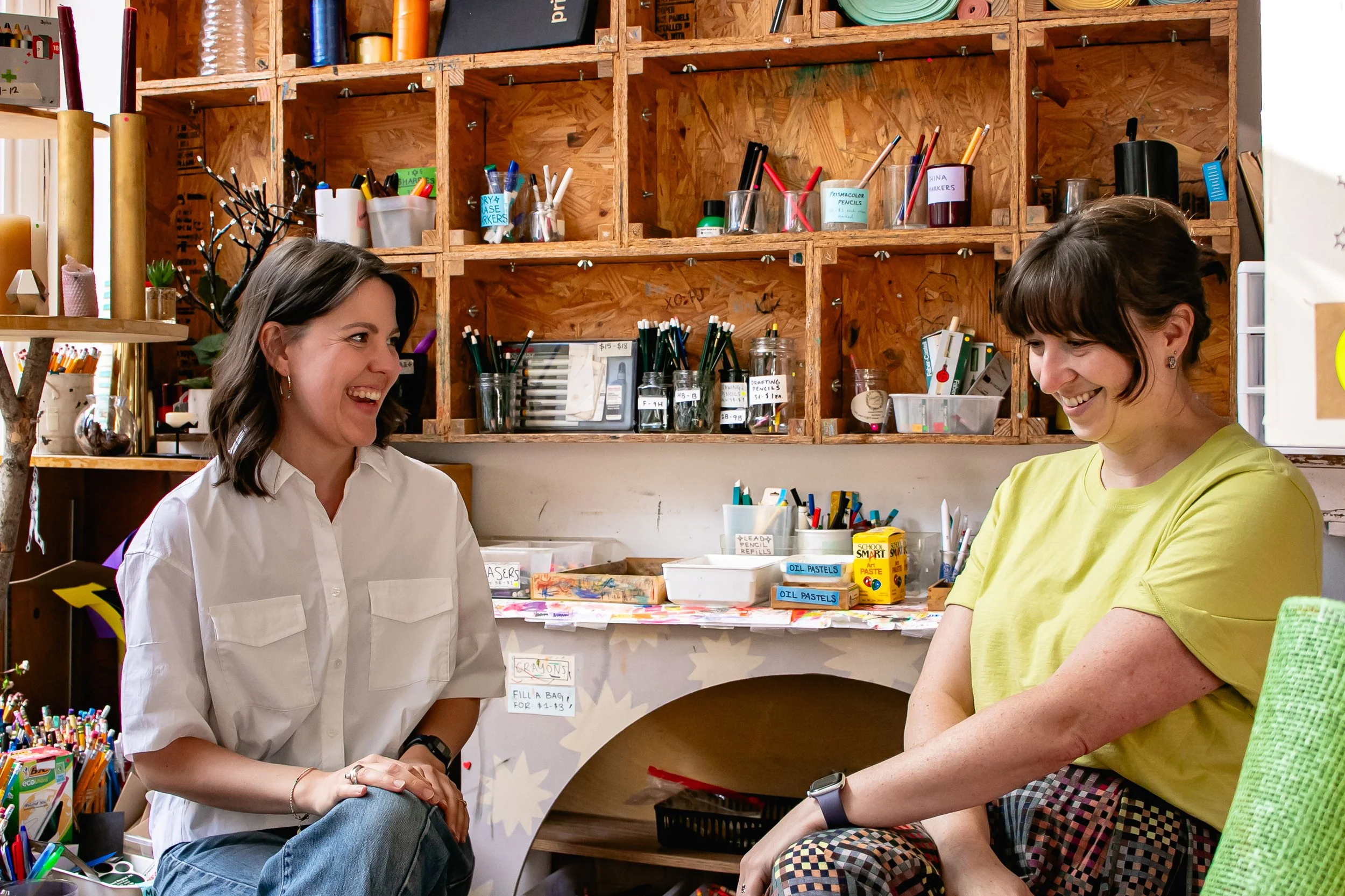
Tell us about an influential woman in your life.
The person who immediately came to mind is Erin Lockridge.
She is based in Norwood and is a good friend. I've known her for a long time. She's actually the godmother of my child. She and her husband, Robert, were actually influential in how we came up with our pay-what-you-can system here at Indigo Hippo. At the time, Erin and Robert had a pizza parlor in Norwood that was pay-what-you-can, and now it's transitioned into a cafe. So the original pizza parlor was called Moriah Pie, and they engage in what you call parish farming. They farm the land of Norwood, and they have gardens all over the place. They have fruit trees, they have vegetables, they harvest mulberries, and they make food and then feed Norwood, which is super inspiring.
And she's also an artist and does a lot of printmaking that comes from her lived experience. So her pieces are just so connected to what she's living, and that has a lot to do with nature and people. I'm always learning from her. I would say she is somebody who has a lot of passion. I don't think I've ever met somebody who's so fiery but brings so much peace to a room. So I always find that inspiring, just how she moves through the world and is always connecting ideas of depth to whatever's happening in your conversation or in life.
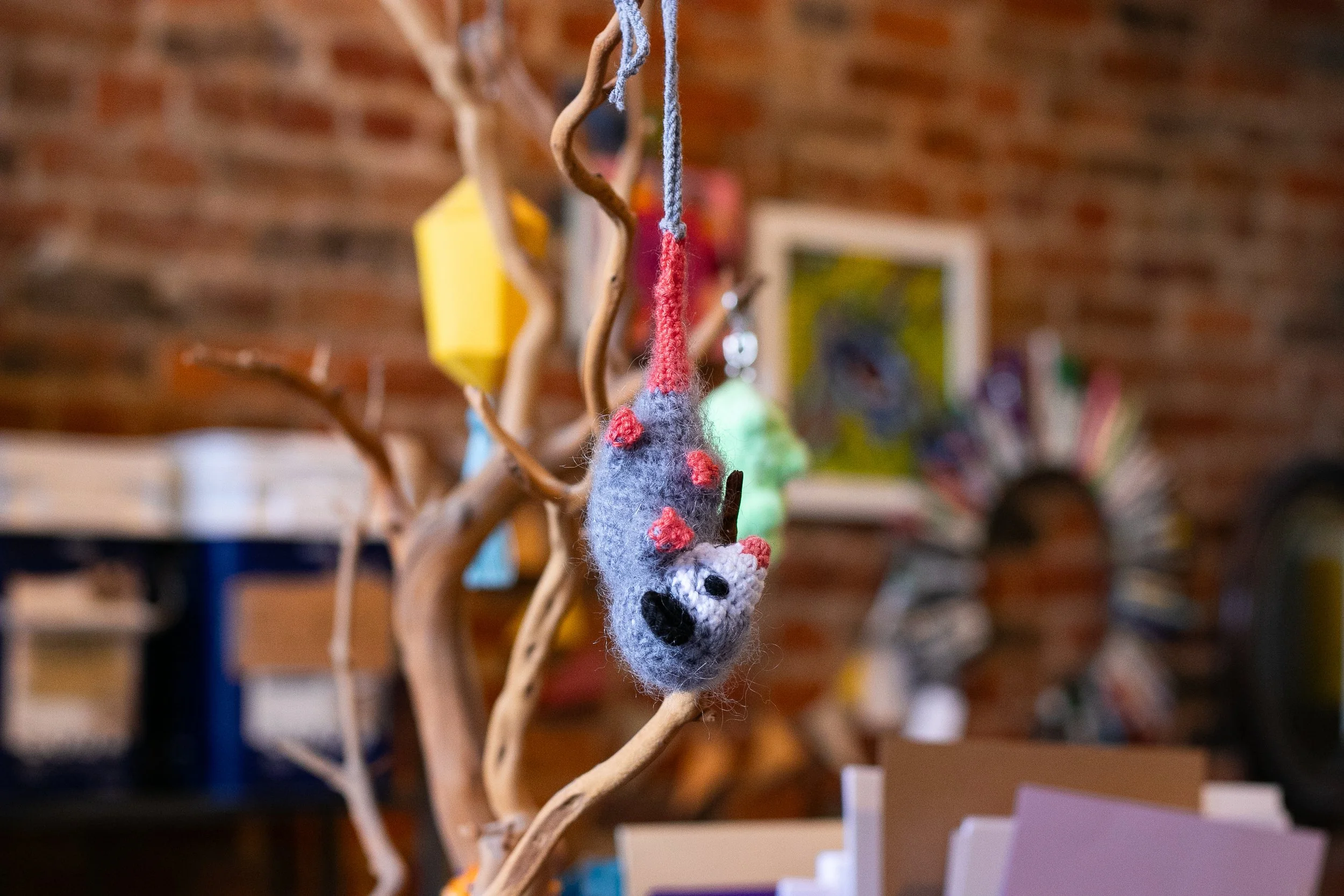
What is bringing you joy lately?
One thing that's really bringing me joy is one of my favorite wildflower weeds – chicory. So that, like, spriggy, blue, on the highway. Every time I'm driving on the highway, I see that, and that is bringing me a lot of joy.
Also, sunshine late into the evening has been wonderful. And fireflies- I love fireflies; that just makes me think of childhood. Just summer nights.
What is your vision or hope for the future of this place?
I would love to grow to the point of having some more staff members and diversify all the hats we wear, which I think is probably something most places want to do. I've always had the dream to have an art residency connected with Indigo Hippo. More opportunities for artists. I would love to have a maker-space or a studio-space connected. Teaching ways to use the materials we have around us. To have a space where we can have more workshops and bring other artists in to teach more fine art mediums, but still accessible, with a low barrier of entry to learning things.
What are you most in need of? How can people support this mission?
Operational support and operational dollars. It allows our current staff to have the support they need to keep going; we can bring in the people to help make it all happen; everybody gets paid a living wage; and then we can offer more to the community.
Indigo Hippo is located at 1334 Main St in OTR, and their online shop also offers in-store or curbside pickup.